Dyna-Living 300 Slices/Hour Commercial Conveyor vs Dyna-Living 450 Slice Commercial Conveyor: Spec Comparison
As an Amazon Associate we earn from qualifying purchases. Links on this page are affiliate links.
You are comparing the dyna living commercial conveyor toaster 450 vs commercial conveyor options from Dyna-Living. Both units share identical features, including seven browning levels, three baking modes, and food-grade stainless steel construction. The main difference lies in their output capacity and physical footprint. The 300 slices-per-hour model is narrower, while the 450 slices-per-hour version offers higher throughput. You need to decide which speed and size fit your kitchen layout.
Key differences
| Aspect | Dyna-Living 300 Slices/Hour Commercial Conveyor Toaster | Dyna-Living 450 Slice Commercial Conveyor Toaster |
|---|---|---|
| Capacity | 300 slices/hour | 450 slices/hour |
| Width | 10.4 inches | 14.6 inches |
| Height | 15.4 inches | 15.2 inches |
| Model Number | TT-300 | BI006977 |
| Length | 20.5 inches | 20.5 inches |
Which one should you choose?
Choose Dyna-Living 300 Slices/Hour Commercial Conveyor Toaster if
- You have limited counter space and need a narrower unit.
- Your volume requirements are around 300 slices per hour.
- You prefer a slightly taller appliance for your specific cabinet height.
Choose Dyna-Living 450 Slice Commercial Conveyor Toaster if
- You need to produce 450 slices per hour for high-volume service.
- You have a wider countertop available for the 14.6-inch width.
- You want the most compact height option at 15.2 inches.
Verdict: Choose the 300 slices/hour model if your counter space is tight or your volume is moderate. Select the 450 slices/hour model if you need faster output and have the width available. Both share the same controls and build quality, so the decision rests on capacity and dimensions.
Capacity and Footprint Comparison
Output capacity
The primary difference between these two units is their hourly toast production. The Dyna-Living 300 Slices/Hour Commercial Conveyor Toaster processes 300 pieces per hour. The Dyna-Living 450 Slice Commercial Conveyor Toaster handles 450 pieces in the same timeframe. This 50% increase in speed makes the 450 model better for high-volume environments. You should choose the 300 model if your daily volume is moderate. Choose the 450 model if you serve large groups or run a busy commercial kitchen where speed is critical for turnover.
Physical dimensions
Size matters for countertop space. The 300 model measures 10.4 inches in width, 15.4 inches in height, and 20.5 inches in length. The 450 model is wider at 14.6 inches, with a slightly lower height of 15.2 inches, while sharing the same 20.5-inch length. The extra width of the 450 model accommodates its higher capacity mechanism. If you have a narrow prep station, the 300 model fits more easily. The 450 model requires a wider counter area but offers a slightly shorter profile.
Control settings
Both toasters offer identical control options for versatility. Each unit features seven distinct browning levels. This allows you to adjust the darkness of the toast precisely. Both also include three specific baking modes: Bread, Buns, and STBY. These modes optimize heat distribution for different food types. Whether you choose the 300 or 450 model, you get the same level of manual control. There is no difference in how you operate the heating elements or select the cooking mode.
Construction material
Build quality is consistent across both models. Both the Dyna-Living 300 and 450 use food-grade thickened stainless steel for the exterior. This material ensures durability and resistance to corrosion in commercial settings. The internal chain net is also made from food-grade 304 stainless steel. This guarantees safe contact with your food. Both units feature four non-slip feet for stability. The material choice does not vary between the two, so safety and longevity are equal.
Output direction
Flexibility in serving is a key feature for both units. Each toaster allows you to switch between front and rear output modes. You can direct the chute to release toast toward the user or away from them. This adaptability helps you fit the unit into different kitchen layouts. Whether you pick the 300 model or the 450 model, this feature is included. It allows you to adjust the workflow based on your counter space and service style without changing hardware.
Which Dyna-Living Toaster Fits Your Needs
Busy commercial kitchen needing high volume
You need maximum throughput for a busy restaurant or bakery. This model processes 450 slices per hour, which is 50 percent more than the 300-slice alternative. The higher capacity ensures you can meet peak demand without bottlenecks. Both units share the same seven browning levels and three baking modes, so you get consistent results while handling more bread.
Small business with limited counter space
You have a compact kitchen and need to save space. This unit is narrower, measuring 10.4 inches wide compared to the 14.6-inch width of the larger model. It still offers 300 slices per hour, which is sufficient for smaller cafes or offices. The shared features include food-grade stainless steel construction and front or rear output options for flexible placement.
School or office with moderate needs
You serve a moderate number of people daily and do not need industrial speed. This toaster handles 300 slices per hour, which is ample for a typical school lunch line or office breakfast. It features the same seven heating levels and three baking modes as the larger unit. The narrower footprint helps it fit easily on standard countertops in smaller break rooms.
High-volume bakery requiring fast output
You run a high-volume bakery where speed is critical. This model produces 450 slices per hour, allowing you to toast more bread in less time. The shared specifications include a pull-out crumb tray and food-grade chain net for easy cleaning and safety. You get the same three baking modes and seven browning levels, ensuring quality while maximizing your hourly output.
The products compared
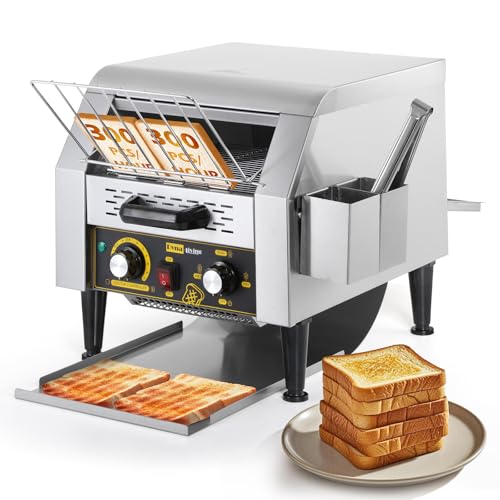
Dyna-Living 300 Slices/Hour Commercial Conveyor Toaster
Best for: steady 300 slices per hour output
- Capacity
- 300 slices/hour
- Cooking Functions
- 3 modes
- Browning Levels
- 7 levels
- Wattage
- 1900W
- Use
- Commercial Use
- Color
- Silver
View on Amazon: Dyna-Living 300 Slices/Hour Commercial Conveyor Toaster Affiliate link
This Dyna-Living commercial conveyor toaster processes 300 slices per hour. It features seven browning levels and three baking modes for bread, buns, and standby. The unit is built with food-grade 304 stainless steel and includes front or rear output chutes. Its compact dimensions of 20.5 inches in length fit standard countertops. You should choose this model if you need a steady, high-volume output for a restaurant or large office setting.
Pros
- Processes 300 slices per hour
- Seven adjustable browning levels
- Three baking modes for bread and buns
- Front or rear output chute options
- Pull-out crumb tray for easy cleaning
Cons
- Lower hourly output than the 450 slice model
- No automatic shut-off timer listed
- Manual control only with no digital display
Good fit if
- You need a reliable 300 slices per hour output
- You require front or rear ejection options
- You want a stainless steel build for durability
Skip if
- You need more than 300 slices per hour
- You want automatic timer controls
- You prefer a smaller footprint
Verdict: Dyna-Living 300 Slices/Hour Conveyor Toaster suits busy kitchens that need a steady 300 slices per hour output without complex digital controls.

Dyna-Living 450 Slice Commercial Conveyor Toaster
Best for: high-volume commercial toast preparation
- Browning Levels
- 7 heating levels
- Wattage
- 1900W
- Use
- Commercial Use
- Color
- Silver
- Intended Use
- Bagels
- Dimensions
- 20.5 × 14.6 × 15.2 inches
View on Amazon: Dyna-Living 450 Slice Commercial Conveyor Toaster Affiliate link
This Dyna-Living commercial conveyor toaster processes 450 slices per hour. It features 7 browning levels and 3 baking modes for precise control. The unit is built with food-grade 304 stainless steel for durability. You can switch between front and rear output chutes to fit your kitchen layout. Its dimensions are 20.5 inches long, 14.6 inches wide, and 15.2 inches high. It includes a pull-out crumb tray for easy maintenance.
Pros
- High throughput of 450 slices per hour
- 7 distinct browning levels for consistent results
- 3 baking modes including bread and buns settings
- Switchable front or rear output chute
- Food-grade 304 stainless steel construction
Cons
- Large footprint requires significant counter space
- Heavier build may limit placement options
- No automatic shut-off timer listed in specs
Good fit if
- You need high-volume toast production
- You require flexible front or rear output
- You want durable stainless steel construction
Skip if
- You have limited counter space
- You need a compact residential unit
- You prefer automatic timer controls
Verdict: Dyna-Living 450 Slice/Hour Conveyor Toaster fits busy kitchens needing steady output. It suits operators who value durable materials and adjustable output directions.
Specifications side by side
| Spec | Dyna-Living 300 Slices/Hour Commercial Conveyor Toaster | Dyna-Living 450 Slice Commercial Conveyor Toaster |
|---|---|---|
| Capacity | 300 slices/hour | not stated |
| Cooking Functions | 3 modes | not stated |
| Browning Levels | 7 levels | 7 heating levels |
| Wattage | 1900W | 1900W |
| Use | Commercial Use | Commercial Use |
| Color | Silver | Silver |
| Intended Use | Bagels | Bagels |
| Dimensions | 20.5 × 10.4 × 15.4 inches | 20.5 × 14.6 × 15.2 inches |
| Size | 300 PCS/H | 450 PCS/H |
| Model | TT-300 | BI006977 |
Frequently asked questions
What is the main difference between the Dyna-Living 300 and 450 slice conveyor toasters?
The primary difference is their hourly output capacity. The 300-slice model processes 300 pieces per hour, while the 450-slice version handles 450 pieces in the same timeframe. Both units are designed for commercial use and share similar construction materials. You should choose the model that matches your kitchen's daily volume requirements.
How do the physical dimensions of these two conveyor toasters compare?
Both toasters share the same length of 20.5 inches. However, the 450-slice model is wider at 14.6 inches compared to the 300-slice model's 10.4-inch width. The heights are also slightly different, with the 300-slice unit standing at 15.4 inches and the 450-slice unit at 15.2 inches. Plan your counter space accordingly.
Which Dyna-Living conveyor toaster is better for high-volume commercial kitchens?
The Dyna-Living 450 Slice Commercial Conveyor Toaster is better for high-volume needs. It processes 450 slices per hour, offering a 50 percent increase over the 300-slice model. This higher throughput suits busy restaurants or bakeries that need to keep up with peak demand without slowing down service during rush hours.
Are both Dyna-Living conveyor toasters suitable for commercial use?
Yes, both models are explicitly designed for commercial use. They are built to handle the demands of professional kitchens. The 300-slice model suits steady output needs, while the 450-slice model fits operators requiring higher volume. Both feature durable construction to withstand frequent daily operation in a professional environment.
What are the model numbers for these Dyna-Living conveyor toasters?
The Dyna-Living 300 Slices/Hour Commercial Conveyor Toaster has the model number TT-300. The Dyna-Living 450 Slice Commercial Conveyor Toaster carries the model number BI006977. Knowing these model numbers helps you identify the correct unit when ordering parts or consulting technical documentation for your specific equipment.
Do these conveyor toasters come in different colors?
Both the 300-slice and 450-slice models are available in silver. The finish is consistent across both units, providing a professional look for commercial kitchens. Since both share this color attribute, your choice should depend on capacity and size requirements rather than aesthetic differences in the exterior finish.
How much wider is the 450-slice model compared to the 300-slice model?
The 450-slice model is 4.2 inches wider than the 300-slice model. The 450-slice unit measures 14.6 inches in width, while the 300-slice unit is 10.4 inches wide. This additional width accommodates the higher throughput mechanism. Ensure your counter space can handle this extra width before purchasing.