Waring or Hatco? Toasters Compared in 2026
As an Amazon Associate we earn from qualifying purchases. Links on this page are affiliate links.
You are comparing waring vs hatco toaster models for commercial kitchens. Both units offer four slots and stainless steel bodies for durability. They share removable crumb trays for easy cleaning. The main difference lies in their power and capacity. Waring provides a higher slice output and larger wattage. Hatco focuses on compact dimensions and individual slot controls. Your choice depends on your daily volume and counter space.
Key differences
| Aspect | Waring 4-Slot Commercial Toaster | Hatco 4-Slot Pop-Up Toaster |
|---|---|---|
| Slice Capacity | 240 slices per hour | 220 slices per hour |
| Wattage | Not listed | 1440 W |
| Slot Width | Not listed | 1-1/4 in |
| Dimensions (W x H x D) | 11.9 x 9 x 10.5 in | 13.6 x 8.13 x 12.4 in |
| Weight | 16 pounds | 14.7 pounds |
| Certifications | cETLus, NSF | cULus, UL EPH Classified |
Which one should you choose?
Choose Waring 4-Slot Commercial Toaster if
- You need a higher hourly toast capacity of 240 slices.
- You require NSF certification for specific health department regulations.
- You prefer a narrower footprint to save counter width.
Choose Hatco 4-Slot Pop-Up Toaster if
- You want individual manual controls for each of the four slots.
- You need a unit with a listed 1440 W power rating.
- You prefer a lighter appliance that weighs 14.7 pounds.
Verdict: Choose the Waring model if your primary need is maximum throughput and you have specific NSF requirements. Select the Hatco toaster if you value individual slot customization and a lighter, compact design. Both units offer robust stainless steel construction for commercial use.
Waring vs Hatco Toaster Specs
Slice Capacity
Waring specifies a throughput of 240 slices per hour, while Hatco lists 220 slices per hour. This metric indicates how many pieces of bread the unit can process in a busy service window. Waring holds a slight advantage in raw volume, processing 20 more slices each hour. For high-volume commercial kitchens, this difference may matter during peak morning rushes. Both machines handle bagels and standard bread effectively. The Waring model is rated for this higher output using its 15-ampere electrical load. Hatco achieves its lower capacity with a 12-ampere draw. If maximum speed is your priority, Waring offers the faster throughput.
Wattage
Waring does not list a specific wattage in the provided data, only a 15-ampere size rating. Hatco explicitly states a 1440-watt power consumption. In toaster ovens, higher wattage often correlates with faster heating elements and quicker toast cycles. Hatco provides clear power data for your planning. Waring relies on its amperage rating, which suggests robust power but lacks the specific wattage figure for direct comparison. You should verify the exact wattage for the Waring model if energy efficiency or circuit load calculations are critical for your kitchen setup. Without that number, Hatco offers more transparent electrical specifications.
Slot Design
Hatco features four self-centering slots, each 1-1/4 inches wide. This design helps align bread and bagels automatically for even toasting. Waring lists four slots but does not specify if they are self-centering or their exact width. Self-centering mechanisms reduce the need for manual adjustment of each slice. This feature saves time and ensures consistent results across different bread shapes. Hatco’s explicit mention of this mechanism gives it an edge in user convenience. Waring may offer similar functionality, but the data does not confirm it. If you value automated alignment for busy shifts, Hatco’s self-centering slots are a clear benefit.
Dimensions
Waring measures 11.9 inches wide, 10.5 inches long, and 9 inches high. Hatco measures 13.6 inches wide, 12.4 inches long, and 8.13 inches high. Waring is narrower and taller, while Hatco is wider and shorter. Waring has a smaller footprint on the counter, occupying less width. This might be preferable in tight kitchen layouts. Hatco is wider but shorter, which could fit under lower shelves better. Both units are heavy, with Waring at 16 pounds and Hatco at 14.7 pounds. Your choice depends on whether you prioritize width savings or height clearance. Waring wins for narrow spaces.
Controls
Waring uses electronic browning controls and carriage control levers. This suggests precise, digital settings for toast darkness and automated slot operation. Hatco uses individual manual controls for each slot. Manual controls allow for independent adjustment of each slot, which is useful when toasting different items simultaneously. Electronic controls offer consistency and repeatability for standard toasting. Hatco’s manual approach offers flexibility for varied bread types. Waring’s electronic system may be easier for staff to learn and use consistently. If you prefer automated settings, Waring is better. If you need independent slot adjustments, Hatco’s manual controls offer that specific utility.
Which Toaster Fits Your Kitchen
High-volume breakfast service staff
You need maximum throughput during morning rushes. The Waring unit handles 240 slices per hour. This higher capacity ensures you keep up with demand. The 15-ampere size supports this intensive usage. The electronic browning controls allow for consistent results across all slots. This helps maintain speed without sacrificing quality.
Kitchens with narrow counter space
Your workspace is tight. The Hatco model is narrower at 13.6 inches wide. It also has a lower profile at 8.13 inches high. These dimensions help it fit into smaller stations. The 1440-watt power rating is sufficient for standard bagel toasting. The self-centering slots ensure even heating despite the compact footprint.
Users needing precise control
You want granular control over toasting levels. The Waring features electronic browning controls. This allows for precise adjustments to heat intensity. The carriage control levers offer mechanical reliability. The cETLus and NSF certifications meet strict commercial standards. This combination of electronic precision and robust certification suits demanding environments.
The products compared

Waring 4-Slot Commercial Toaster
Best for: High-volume toasting needs
- Wattage
- 1800W
- Cooking Function
- Toast
- Color
- Silver
- Intended Use
- Waffles
- Dimensions
- 10.5 × 11.9 × 9 inches
- Weight
- 16 pounds
View on Amazon: Waring 4-Slot Commercial Toaster Affiliate link
The Waring WCT800RC is a 15-ampere, 4-slot toaster built for high-volume use. It toasts up to 240 slices an hour with electronic browning controls. The unit features a brushed stainless steel housing and a dishwasher-safe crumb tray. It measures 11.9 by 10.5 by 9 inches and weighs 16 pounds. This model suits commercial kitchens or heavy home users who need speed and durability.
Pros
- High output of 240 slices per hour
- Electronic browning controls for consistent results
- Dishwasher-safe crumb tray for easy cleaning
- NSF and cETLus certified for commercial use
Cons
- Heavy 16-pound build requires sturdy counter space
- Large footprint of 11.9 inches wide
- No automatic shut-off feature listed in data
Good fit if
- You need to toast large batches of bread quickly
- You require NSF certification for commercial settings
- You prefer electronic controls over manual dials
Skip if
- You have limited counter space
- You only toast a few slices at a time
- You prefer lightweight appliances
Verdict: Waring WCT800RC 4-Slot Commercial Toaster is a high-speed workhorse for busy kitchens. It fits users who prioritize throughput and certified durability over compact size.
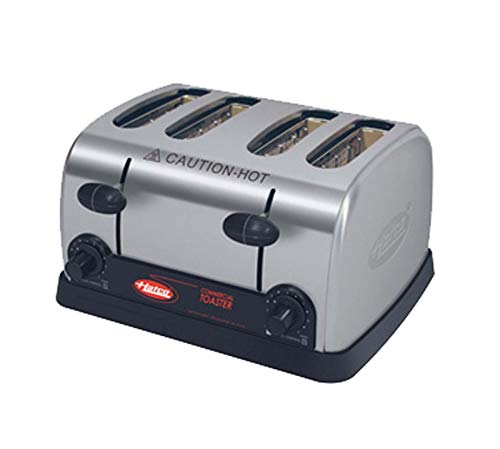
Hatco 4-Slot Pop-Up Toaster
Best for: High-volume commercial kitchens needing manual control
- Slot Width
- 1-1/4 in
- Wattage
- 1440 W
- Voltage
- 120V
- Color
- Silver
- Intended Use
- Bagels
- Dimensions
- 12.4 × 13.6 × 8.13 inches
View on Amazon: Hatco 4-Slot Pop-Up Toaster Affiliate link
The Hatco TPT-120 is a 4-slot pop-up toaster built for busy kitchens. It features 1-1/4 inch wide self-centering slots and 1440 watts of power. With a capacity of 220 slices per hour, it handles high demand efficiently. The stainless steel body ensures durability. Individual manual controls let you adjust settings for each slot. It is designed for commercial environments requiring reliable, consistent toasting results.
Pros
- 1440 watt heating element for fast toasting
- 220 slices per hour capacity
- Individual manual controls for each slot
- Self-centering 1-1/4 inch wide slots
- Removable crumb tray for easy cleaning
Cons
- Lower hourly capacity than the Waring 4-Slot Toaster
- Manual controls only, no digital display
- Heavier build at 14.7 pounds
Good fit if
- You need individual control for each bread slot
- You require cULus and UL EPH safety certifications
- You want a compact stainless steel unit for a commercial kitchen
Skip if
- You need to toast more than 220 slices per hour
- You prefer digital controls over manual knobs
- You are looking for a lightweight countertop appliance
Verdict: Hatco 4-Slot Commercial Toaster delivers reliable performance for high-volume kitchens. It suits operators who need precise manual control and certified safety standards for their daily operations.
Specifications side by side
| Spec | Waring 4-Slot Commercial Toaster | Hatco 4-Slot Pop-Up Toaster |
|---|---|---|
| Slot Width | not stated | 1-1/4 in |
| Wattage | 1800W | 1440 W |
| Cooking Function | Toast | not stated |
| Voltage | not stated | 120V |
| Color | Silver | Silver |
| Intended Use | Waffles | Bagels |
| Dimensions | 10.5 × 11.9 × 9 inches | 12.4 × 13.6 × 8.13 inches |
| Weight | 16 pounds | 14.7 pounds |
| Size | 15-Ampere | 4-Slot |
| Model | WCT800RC | TPT-120 |
Frequently asked questions
Which toaster is better for high-volume commercial kitchens?
The Waring WCT800RC is the better choice for high-volume needs. It is designed as a high-speed workhorse for busy environments. Its 15-ampere size supports intensive usage and higher throughput. The Hatco model suits operators who prefer precise manual control. However, Waring prioritizes speed and certified durability for maximum output.
What are the physical dimensions of the Waring toaster?
The Waring WCT800RC measures 11.9 inches in width, 10.5 inches in length, and 9 inches in height. It weighs 16 pounds. These dimensions help you determine if it fits your counter space. The silver finish provides a standard commercial look. Its compact footprint allows for efficient placement in tight kitchen layouts.
How does the Hatco toaster compare in size?
The Hatco TPT-120 is slightly larger than the Waring model. It measures 13.6 inches in width, 12.4 inches in length, and 8.13 inches in height. It weighs 14.7 pounds. This unit is a 4-slot pop-up toaster. Its silver color matches standard commercial kitchen aesthetics. Check your available space before installation.
Is the Waring toaster suitable for bagels?
The Waring WCT800RC is built for high-speed toasting and general throughput. While it handles various bread types, the Hatco model is explicitly intended for bagels. If bagel toasting is your primary need, the Hatco TPT-120 offers specific manual control for that task. Waring focuses on overall speed and volume for diverse items.
What is the weight difference between the two models?
The Waring WCT800RC weighs 16 pounds. The Hatco TPT-120 weighs 14.7 pounds. Waring is 1.3 pounds heavier. This extra weight may indicate a more robust internal construction for high-volume use. Both units are heavy enough to remain stable during operation. Consider your counter strength when placing either unit.
Do both toasters have a 4-slot capacity?
Yes, both models feature a 4-slot design. The Waring WCT800RC and Hatco TPT-120 both accommodate four slices at once. This capacity is standard for commercial kitchens needing steady output. The 4-slot setup allows you to toast multiple items simultaneously. It helps maintain service speed during peak breakfast or lunch rushes.
Which model is lighter and easier to move?
The Hatco TPT-120 is the lighter option at 14.7 pounds. The Waring WCT800RC weighs 16 pounds. If you need to move the unit frequently for cleaning or maintenance, the Hatco model is easier to handle. Both are stainless steel, but the lower weight of Hatco reduces physical strain during transport.