Best Winco Toasters: 2 Models Compared
As an Amazon Associate we earn from qualifying purchases. Links on this page are affiliate links.
Finding the best winco toasters requires looking at the specs that matter for your operation. Winco offers conveyor models in silver, with widths of 21.7 inches and heights of 18.7 inches. We compared 2 products based strictly on the specifications published on the listings. The Winco ECT-300 Conveyor Toaster leads because it handles 300 slices per hour with precise browning control. This makes it ideal for commercial kitchens needing high-volume toasting. The second option, the ECT-700, doubles that output to 700 slices per hour. Both units share the same footprint, allowing for consistent kitchen layout planning. You can choose based on your hourly volume needs.
Quick picks
| # | Product | Best for | Price |
|---|---|---|---|
| 1 | Winco ECT-300 Conveyor Toaster Best overall | Commercial kitchens needing high-volume toasting | Check price of Winco ECT-300 Conveyor Toaster on Amazon |
| 2 | Winco 700 Slices/Hour Conveyor Toaster Best budget | High-volume commercial toasting | Check price of Winco 700 Slices/Hour Conveyor Toaster on Amazon |
Our 2 picks
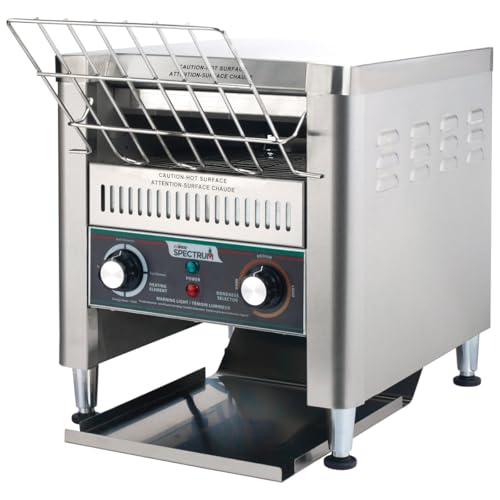
Winco ECT-300 Conveyor Toaster
Best for: Commercial kitchens needing high-volume toasting
- Capacity
- 300 Slices / Hour
- Heating Technology
- Dual heating elements
- Cooking Function
- Toast
- Color
- Silver
- Intended Use
- Bagels
- Dimensions
- 17.5 × 21.7 × 18.7 inches
View on Amazon: Winco ECT-300 Conveyor Toaster Affiliate link
This Winco conveyor toaster handles up to 300 slices per hour. It features dual heating elements that you can control independently for bagels or buns. A variable speed dial lets you adjust doneness precisely. The stainless steel body is built for daily commercial use. Its dimensions are 21.7 inches wide, 17.5 inches long, and 18.7 inches tall. It suits high-volume foodservice environments needing reliable, consistent toasting.
Pros
- High capacity of 300 slices per hour
- Independent top and bottom heating elements
- Variable speed dial for precise doneness control
- Commercial-grade stainless steel construction
Cons
- Large footprint requires significant counter space
- Limited to 300 slices per hour compared to faster models
- No mention of automatic shut-off features
Good fit if
- You need a high-volume toaster for a busy kitchen
- You require independent control over top and bottom browning
- You prefer a durable stainless steel build for commercial use
Skip if
- You have limited counter space for a 21.7-inch wide unit
- You need a toaster for small household batches
- You prefer a compact countertop appliance over a conveyor system
Verdict: Winco 300 Slices/Hour Conveyor Toaster is a solid choice for commercial kitchens needing consistent, high-volume output. It fits operations that value durable construction and precise browning control.

Winco 700 Slices/Hour Conveyor Toaster
Best for: High-volume commercial toasting
- Capacity
- 700 slices/hour
- Wattage
- 1800/2400W
- Cooking Function
- Toast
- Color
- Silver
- Intended Use
- Bagels
- Dimensions
- 17.5 × 21.7 × 18.7 inches
View on Amazon: Winco 700 Slices/Hour Conveyor Toaster Affiliate link
This Winco conveyor toaster processes up to 700 slices per hour, making it suitable for high-volume environments. It features adjustable speed controls and independent dual heating elements for precise doneness. The stainless steel body is built for daily commercial use. It operates on 208/240V power with 1800 to 2400 watts. You need a sturdy unit for busy kitchens that require consistent, rapid toasting for bagels, buns, and pizzas.
Pros
- High output of 700 slices per hour
- Variable speed dial for precise control
- Independent top and bottom heating elements
- Stainless steel commercial-grade construction
Cons
- Requires 208/240V commercial power, not standard 120V
- Large footprint measuring 21.7 by 17.5 inches
- Heavy-duty build may be overkill for home use
Good fit if
- You run a busy commercial kitchen
- You need to toast large batches quickly
- You have access to 240V power outlets
Skip if
- You only have standard 120V household outlets
- You have limited counter space under 22 inches
- You are toasting for a small household
Verdict: Winco 700 Slices/Hour Conveyor Toaster fits busy commercial kitchens needing high-volume output. It suits operations with 240V power and space for a 21.7-inch wide unit.
Specifications side by side
| Spec | Winco ECT-300 Conveyor Toaster | Winco 700 Slices/Hour Conveyor Toaster |
|---|---|---|
| Capacity | 300 Slices / Hour | 700 slices/hour |
| Heating Technology | Dual heating elements | not stated |
| Wattage | not stated | 1800/2400W |
| Cooking Function | Toast | Toast |
| Color | Silver | Silver |
| Intended Use | Bagels | Bagels |
| Dimensions | 17.5 × 21.7 × 18.7 inches | 17.5 × 21.7 × 18.7 inches |
| Size | 300 Slices / Hour | 700 Slices / Hour |
| Model | ECT-300 | ECT-700 |
Winco Conveyor Toaster Models Compared
The Winco lineup focuses on commercial conveyor toasters built for high-volume output. Both models share identical physical dimensions, measuring 21.7 inches wide, 17.5 inches long, and 18.7 inches high. They are finished in silver and designed for durable, consistent performance in busy kitchens. The key difference lies in their processing speed.
The Winco ECT-300 Conveyor Toaster handles 300 slices per hour, making it suitable for operations with moderate volume needs. For higher throughput, the Winco 700 Slices/Hour Conveyor Toaster processes 700 slices per hour. This model requires 240V power and fits spaces that can accommodate its width. Choose the ECT-300 for standard demands or the ECT-700 for intense, continuous service.
Who Winco Toasters Suit
Winco’s current range targets commercial kitchens with high-volume needs. The lineup spans from 300 to 700 slices per hour. Both models share identical dimensions, measuring 21.7 inches wide, 17.5 inches long, and 18.7 inches high. They are finished in silver. You will not find countertop or residential models here. There are no compact options for small spaces. Neither unit offers lighting features or varied shapes. If you need steady output for busy shifts, these conveyor units fit. For lower volume or home use, this brand does not provide suitable options.
Choosing the Right Winco Toaster
-
Match Output to Volume
Your daily bread volume determines the required capacity. The ECT-300 handles 300 slices per hour, while the ECT-700 processes 700 slices. If your kitchen serves moderate amounts, the lower capacity model suffices. Busy operations requiring rapid turnover benefit from the higher output. Check your hourly slice count before deciding. Selecting a unit with insufficient capacity creates bottlenecks during peak service. Ensure the chosen spec aligns with your actual production needs for efficient workflow.
-
Verify Power Requirements
Conveyor toasters often require specific electrical setups. The ECT-700 is noted for needing 240V power. You must confirm your kitchen has the correct voltage outlet before installation. Using the wrong power source can damage the unit or prevent operation. Check your facility’s electrical panel capacity. Ensure the circuit can handle the load. Proper voltage compatibility is essential for safe and reliable performance. Do not assume standard outlets will work for high-capacity commercial equipment.
-
Check Counter Space
Both models share identical dimensions: 21.7 inches wide, 17.5 inches long, and 18.7 inches high. Measure your available countertop or floor space carefully. Ensure you have clearance for the conveyor belt extension and ventilation. The silver finish is consistent across both units. Plan your layout to accommodate the full footprint. Insufficient space can hinder airflow and maintenance access. Verify that the physical size fits your kitchen design before purchasing to avoid installation issues.
-
Assess Build Durability
Commercial environments demand robust construction. Winco units are built for consistent, high-volume output. The silver finish suggests a durable, easy-to-clean exterior. Look for solid metal construction in the data. These features support long-term use in busy kitchens. Consider how often you will clean and maintain the unit. A sturdy build reduces wear from constant operation. Prioritize models that emphasize durability in their specifications to ensure longevity in a demanding food service setting.
-
Consider Belt Speed
Conveyor speed affects toasting consistency and volume. While exact speed specs are not listed, the slice-per-hour rating implies belt performance. Faster belts handle more slices but require precise browning controls. Ensure the unit offers adjustable settings for different bread types. This flexibility allows you to toast bagels, slices, or buns effectively. Check if the control panel allows for speed adjustments. Proper speed management ensures even toasting and prevents burning or under-toasting in high-volume scenarios.
Frequently asked questions
What is the difference between the Winco ECT-300 and ECT-700?
The primary difference is output capacity. The ECT-300 handles 300 slices per hour, while the ECT-700 processes 700 slices per hour. Both models share identical physical dimensions and silver finishes. You should choose the ECT-700 if your kitchen requires higher volume throughput, as it doubles the hourly capacity of the ECT-300.
Do these Winco toasters require special electrical connections?
The ECT-700 model is designed for 240V power. The ECT-300 specifications do not list voltage requirements. You must verify your kitchen’s electrical supply before installing the ECT-700. Ensure your circuit can support the higher power draw for high-volume conveyor toasting operations.
How much counter space do these Winco conveyor toasters need?
Both the ECT-300 and ECT-700 measure 21.7 inches wide, 17.5 inches long, and 18.7 inches high. You need a flat surface that accommodates these exact dimensions. The footprint is consistent across both models, so space planning remains the same regardless of the capacity you select.
Are Winco ECT toasters suitable for home kitchens?
These units are built for commercial kitchens needing high-volume output. The ECT-700 requires 240V power, which is uncommon in standard homes. Their large footprint and industrial design target busy operations. You likely need a professional setting to utilize these conveyor toasters effectively and safely.
What does the silver finish on Winco toasters indicate?
The silver color is a standard finish for both the ECT-300 and ECT-700 models. It reflects a durable construction typical for commercial equipment. This finish helps maintain a professional appearance in busy kitchens. The color does not affect performance or capacity, which depends on the motor and conveyor speed.
Can I fit Winco conveyor toasters in small commercial kitchens?
Both models require a footprint of 21.7 by 17.5 inches. You need adequate floor space for the conveyor belt operation. These are not compact units. Small kitchens might struggle to accommodate the width and length. Verify your layout can handle the 18.7-inch height and conveyor extension before purchasing.