Winco 700 Slices/Hour Conveyor Toaster vs Winco 300 Slices/Hour Conveyor Toaster: Spec Comparison
As an Amazon Associate we earn from qualifying purchases. Links on this page are affiliate links.
You are looking at the winco 700 slices hour conveyor toaster vs 300 slices hour conveyor models from Winco. Both units share the same stainless steel commercial-grade body and identical physical dimensions. They both feature dual heating elements with independent control and variable speed dials for precise doneness adjustments. The primary difference lies in their output capacity and electrical requirements. One model handles a higher volume of slices per hour, while the other is designed for lower throughput. This affects their power needs and suitability for different kitchen environments.
Key differences
| Aspect | Winco ECT-300 Conveyor Toaster | Winco 700 Slices/Hour Conveyor Toaster |
|---|---|---|
| Capacity | 300 Slices / Hour | 700 Slices / Hour |
| Model | ECT-300 | ECT-700 |
| Wattage | not listed | 1800/2400W |
| Voltage | not listed | 208/240V~50/60Hz |
| Current | not listed | 8.6/10A |
Which one should you choose?
Choose Winco ECT-300 Conveyor Toaster if
- You need a toaster for lower-volume service or a smaller kitchen.
- You prefer a unit with a simpler electrical setup if your wiring does not support higher amperage.
- You want a compact footprint that matches the larger model but with reduced output.
Choose Winco 700 Slices/Hour Conveyor Toaster if
- You require high throughput for busy breakfast or lunch rushes.
- You have 208V or 240V commercial power available in your kitchen.
- You need the flexibility to handle up to 700 slices per hour efficiently.
Verdict: The ECT-300 is the better choice for low-to-medium volume operations where space and electrical simplicity are priorities. The ECT-700 suits high-volume commercial kitchens that need faster output and have the necessary 208/240V power infrastructure. Both offer the same build quality and control features, so your decision should hinge on your slice-per-hour needs.
Speed and Power Differences
Toast Capacity
The Winco 700 Slices/Hour Conveyor Toaster handles up to 700 slices per hour. This higher output suits busy kitchens needing rapid turnover. The Winco ECT-300 Conveyor Toaster processes 300 slices per hour. This lower rate fits smaller operations or slower service periods. Both units use the same conveyor mechanism. The difference lies entirely in the processing speed rating. You should choose the 700 model if volume is your main concern. Pick the 300 model if your daily volume is lower.
Power Consumption
The Winco 700 Slices/Hour Conveyor Toaster lists specific electrical requirements. It operates at 1800/2400W depending on voltage. It draws 8.6/10A at 208/240V. This data helps you plan your kitchen electrical circuit. The Winco ECT-300 Conveyor Toaster does not list wattage or amperage in the provided specifications. You cannot determine its power draw from the current data. This lack of detail makes electrical planning harder for the 300 model. The 700 model provides clear power specs for installation planning.
Heating Control
Both toasters feature dual heating elements. You can operate the top and bottom elements independently. A three-position dial allows you to select which elements are active. This setup is ideal for toasting bagels, buns, and pizzas. Both units offer this same cooking function. The control mechanism is identical on both models. You get the same flexibility in how you toast different items. There is no difference in heating technology or control options between the two units.
Speed Adjustment
Each toaster includes a variable speed dial. This dial allows you to adjust the conveyor belt speed. You can use this to control the doneness of your toast. Slower speeds result in darker toast. Faster speeds produce lighter toast. Both the Winco 700 Slices/Hour Conveyor Toaster and the Winco ECT-300 Conveyor Toaster have this feature. The control type is the same for both. You can fine-tune results on either machine. There is no advantage in speed control for one model over the other.
Physical Footprint
Both toasters share identical physical dimensions. The width is 21.7 inches for both. The height is 18.7 inches for both. The length is 17.5 inches for both. The color is silver for both units. They both feature a stainless steel commercial-grade body. You will need the same amount of counter space for either model. The build quality and exterior finish are the same. You can swap one for the other without changing your kitchen layout.
Choose the right conveyor toaster for you
High-volume commercial kitchens needing speed
The Winco 700 Slices/Hour Conveyor Toaster handles up to 700 slices per hour. This higher output suits busy kitchens needing rapid turnover. Its 2400W power rating supports this increased capacity. You get the same stainless steel body and dual heating elements as the slower model, but with greater throughput for peak service times.
Smaller operations with lower toast demand
The Winco ECT-300 Conveyor Toaster processes 300 slices per hour. This lower rate fits smaller operations or cafes with moderate breakfast rushes. It retains the commercial-grade stainless steel construction and variable speed dial. You get precise doneness control and independent heating elements without needing the higher power draw of the larger unit.
Kitchens requiring 240V electrical connections
The Winco 700 Slices/Hour Conveyor Toaster specifies 208/240V power requirements. If your commercial kitchen is wired for 240V, this unit draws up to 10A at that voltage. This electrical setup supports its higher 2400W output. You ensure the appliance matches your facility's electrical infrastructure while gaining the benefit of faster slice processing during busy periods.
The products compared
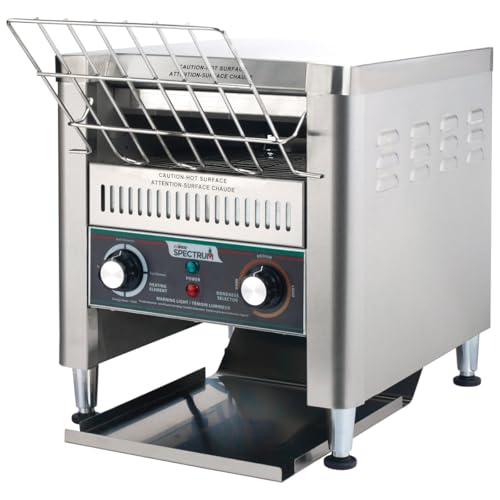
Winco ECT-300 Conveyor Toaster
Best for: moderate-volume commercial toasting
- Capacity
- 300 Slices / Hour
- Heating Technology
- Dual heating elements
- Cooking Function
- Toast
- Color
- Silver
- Intended Use
- Bagels
- Dimensions
- 17.5 × 21.7 × 18.7 inches
View on Amazon: Winco ECT-300 Conveyor Toaster Affiliate link
This Winco conveyor toaster handles 300 slices per hour. It features dual heating elements with independent control for bagels and buns. The variable speed dial lets you adjust doneness precisely. The stainless steel body is built for daily commercial use. It measures 21.7 inches wide. This unit suits high-volume kitchens needing reliable, consistent toasting without excessive space requirements.
Pros
- Handles 300 slices per hour
- Variable speed dial for precise doneness
- Independent top and bottom heating elements
- Stainless steel commercial-grade construction
Cons
- Lower hourly capacity than the 700-slice model
- Larger footprint at 21.7 inches wide
- No mention of digital display or timer
Good fit if
- You need moderate volume toasting
- You require adjustable browning control
- You prefer stainless steel durability
Skip if
- You need maximum throughput speed
- You have limited counter space
- You want digital automation features
Verdict: Winco 300 Slices/Hour Conveyor Toaster fits kitchens needing steady, adjustable toasting for moderate volumes. It offers reliable commercial build quality without the bulk of higher-capacity units.

Winco 700 Slices/Hour Conveyor Toaster
Best for: High-volume commercial toasting operations
- Capacity
- 700 slices/hour
- Wattage
- 1800/2400W
- Cooking Function
- Toast
- Color
- Silver
- Intended Use
- Bagels
- Dimensions
- 17.5 × 21.7 × 18.7 inches
View on Amazon: Winco 700 Slices/Hour Conveyor Toaster Affiliate link
This Winco ECT-700 conveyor toaster handles up to 700 slices per hour. It features dual heating elements that operate independently via a three-position dial. The variable speed dial lets you adjust toasting precision. The stainless steel body is built for commercial daily use. It runs on 208/240V power with 1800/2400W wattage. This unit suits high-volume foodservice operations needing reliable, fast toasting.
Pros
- High capacity of 700 slices per hour
- Dual heating elements for independent top and bottom control
- Variable speed dial for precise doneness adjustments
- Commercial-grade stainless steel construction
Cons
- Requires 208/240V electrical connection, not standard 120V
- Large footprint at 21.7 inches wide
- No automatic shut-off timer mentioned in specs
Good fit if
- You need to toast 700 slices per hour
- You have 208/240V power available
- You require independent control of top and bottom heating elements
Skip if
- You only have standard 120V outlets
- You need a compact countertop appliance
- You want automatic timer controls
Verdict: Winco 700 Slices/Hour Conveyor Toaster fits busy commercial kitchens that need high-volume toasting with manual speed control. It is not suitable for homes or small cafes without heavy-duty wiring.
Specifications side by side
| Spec | Winco ECT-300 Conveyor Toaster | Winco 700 Slices/Hour Conveyor Toaster |
|---|---|---|
| Capacity | 300 Slices / Hour | 700 slices/hour |
| Heating Technology | Dual heating elements | not stated |
| Wattage | not stated | 1800/2400W |
| Cooking Function | Toast | Toast |
| Color | Silver | Silver |
| Intended Use | Bagels | Bagels |
| Dimensions | 17.5 × 21.7 × 18.7 inches | 17.5 × 21.7 × 18.7 inches |
| Size | 300 Slices / Hour | 700 Slices / Hour |
| Model | ECT-300 | ECT-700 |
Frequently asked questions
Are the physical dimensions the same for both Winco conveyor toasters?
Yes, both the ECT-300 and ECT-700 models share identical external measurements. Each unit measures 21.7 inches in width, 18.7 inches in height, and 17.5 inches in length. This consistency means they will fit in the same footprint on your counter or prep station. You can swap one for the other without adjusting your kitchen layout or shelving space.
Does the 700-slice model require more power than the 300-slice version?
The ECT-700 is designed for higher output and typically draws more power to sustain that speed. While the 300-slice model handles moderate volumes efficiently, the 700-slice unit supports rapid turnover for busy operations. Check your electrical capacity before installing the higher-capacity model, as it may need dedicated heavy-duty wiring to operate safely at full speed.
Which Winco conveyor toaster is best for a small cafe?
The ECT-300 Conveyor Toaster is the better choice for small cafes or moderate-volume kitchens. It processes 300 slices per hour, which is sufficient for steady service without the bulk of higher-capacity units. The 700-slice model is intended for high-volume commercial operations and may be excessive for smaller settings, making the 300-slice version more practical and space-efficient.
Can I use these toasters in a home kitchen?
The 700-slice model is not suitable for homes or small cafes without heavy-duty wiring. It is built for high-volume commercial toasting operations. The ECT-300 is also a commercial-grade unit with a stainless steel body. Neither is designed for residential use, so you should only consider these for professional environments that can handle their size and electrical requirements.
What is the main difference in output between the two models?
The primary difference is the hourly toast capacity. The ECT-700 handles up to 700 slices per hour, while the ECT-300 processes 300 slices per hour. This makes the 700-slice model ideal for kitchens needing rapid turnover. The 300-slice model offers reliable toasting for moderate volumes, providing a balance of speed and manageability for smaller teams.
Do both models have the same color and build quality?
Yes, both toasters feature a silver finish and commercial-grade stainless steel construction. They share the same robust build quality designed for professional kitchens. The only differences lie in their internal capacity and power handling. You get the same durable exterior and professional appearance regardless of which model you choose for your food service operation.